

Credible Law Releases New Guide on Missed MCA Payments, Collections, Lawsuits, Bank Levies, and Frozen Accounts
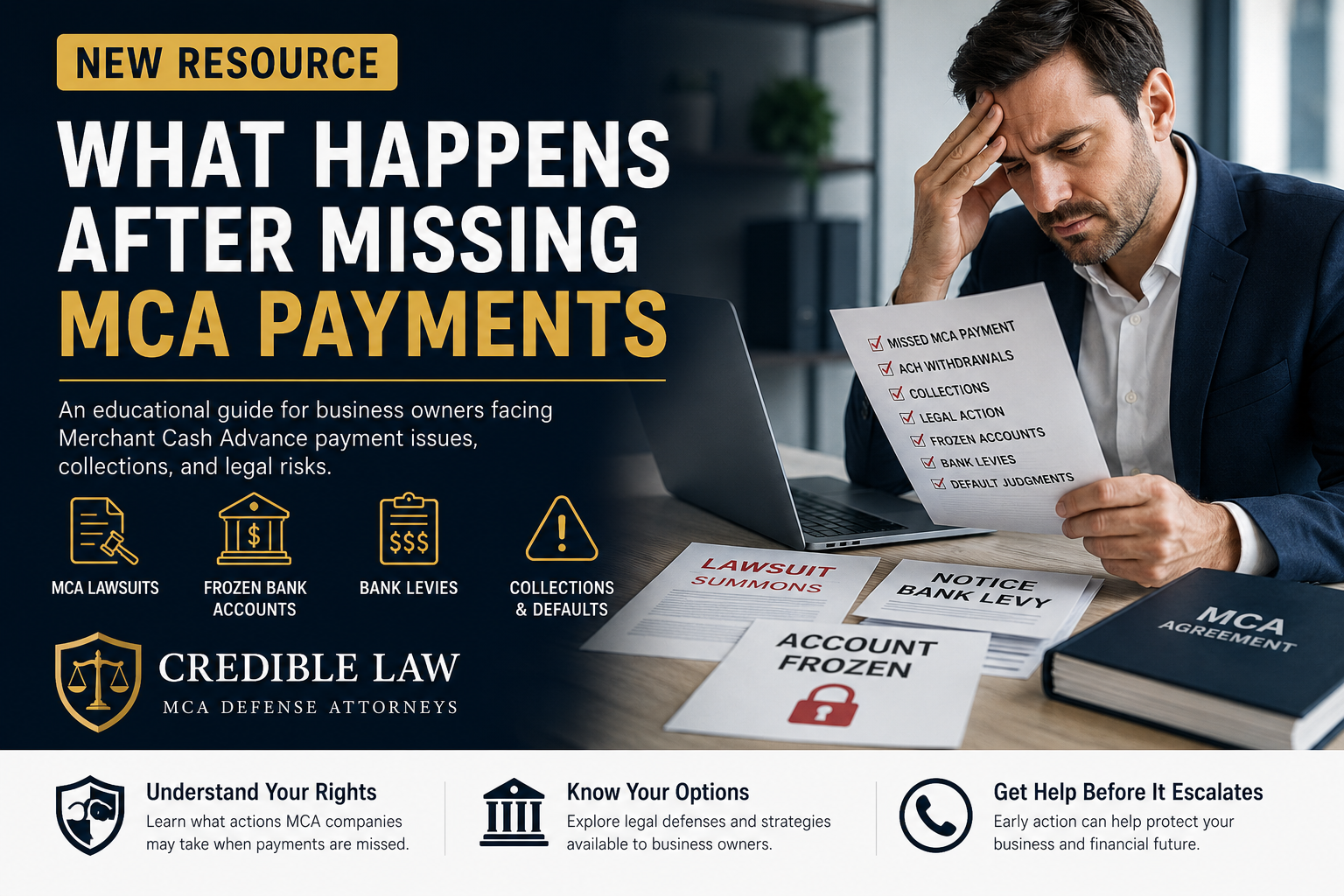
Businesses facing missed Merchant Cash Advance payments may encounter collections, ACH withdrawals, lawsuits, frozen business bank accounts, bank levies, default judgments, and other collection-related challenges.
New resource explains missed MCA payments, collections, ACH withdrawals, lawsuits, frozen business accounts, bank levies, and default risks.
CA, UNITED STATES, June 23, 2026 /EINPresswire.com/ -- Credible Law has expanded its Merchant Cash Advance legal resource center with a new educational guide explaining what business owners may face after missing Merchant Cash Advance (MCA) payments. The resource was developed to help businesses understand how missed payments can escalate, and why understanding those risks early may matter.
Many businesses first encounter trouble as an ordinary cash flow challenge. A slow month, a delayed receivable, or a single returned ACH withdrawal can begin a chain of events that, left unaddressed, may progress well beyond a temporary shortfall. According to the new resource, missed MCA payments can lead to increased ACH withdrawals, collection calls, MCA lawsuits, frozen business bank accounts, bank levies, default judgments, UCC liens, and personal guarantee claims.
The guide was created to help business owners recognize this progression before collection efforts escalate. Rather than addressing problems only after a bank account has been restrained or a judgment entered, the resource is intended to give business owners a clearer picture of the landscape while options may still be available.
Industry Background
Small businesses across the United States continue to navigate persistent cash flow challenges. When traditional bank lending is slow, limited, or unavailable, many turn to alternative financing to cover payroll, inventory, equipment, and day-to-day operations.
Merchant Cash Advance products have become a common funding source within this environment. Structured generally as purchases of future business revenue rather than conventional loans, MCAs are widely used because they are fast to obtain and accessible to businesses that may not qualify for bank financing.
That accessibility, however, comes with repayment obligations that some businesses find difficult to sustain. Because repayment typically occurs through fixed daily or weekly ACH withdrawals, a downturn in revenue can leave a business unable to keep pace with its scheduled payments. The new resource focuses on what may follow when that happens, presented as general educational information rather than as commentary on any individual funder or agreement.
What Happens After Missing MCA Payments?
After missing MCA payments, businesses often experience a recognizable progression. It frequently begins with missed or returned withdrawals, followed by ACH return notices, collection communications, default notices, and, in some cases, litigation.
The sequence typically starts when a scheduled ACH withdrawal does not clear. A funder may treat a missed or returned payment as an event of default under the agreement. From there, MCA collections activity often intensifies, moving from routine contact to more formal demands. A Merchant Cash Advance default can open the door to escalated collection efforts and, ultimately, to a lawsuit seeking to recover the balance the funder claims it is owed.
The new resource explains that this progression is not always immediate, and that the pace can vary considerably depending on the agreement and the funder's practices. Understanding the typical stages, it notes, may help business owners gauge where a situation stands.
Early Warning Signs Businesses Should Not Ignore
The resource highlights several signals that may indicate a situation is escalating. Business owners are encouraged to take note when they observe:
• A noticeable increase in collection activity, including frequent calls
• Daily ACH withdrawals that increase, change, or strain available cash
• Demand letters from an attorney or law firm representing the funder
• Disruptions or holds involving merchant processing accounts
• New UCC filings recorded against the business
Individually, any one of these may have an explanation. Appearing together, they may indicate that collection efforts are advancing, and that reviewing the situation promptly could be important.
Why Many Businesses Wait Too Long to Respond
The resource also addresses a common pattern: businesses frequently wait longer than they should before responding to MCA payment problems. Several factors contribute to this delay.
Owners are often focused on operations, working to keep the business running while revenue is under pressure. Cash flow stress can make it difficult to step back and assess the larger legal picture. Many business owners are also uncertain about the terms of their MCA contracts, which can be complex, and unsure about what options may exist when difficulties arise.
These delays can carry consequences. According to the resource, waiting to respond can sometimes allow a matter to progress toward lawsuits, judgments, and collection actions that might have been approached differently if addressed earlier. The educational materials emphasize awareness of deadlines and timelines, which can be short once litigation begins.
Frozen Business Bank Accounts and Bank Levies
One of the most disruptive developments a business can encounter is a frozen business bank account. Many owners first learn of a serious problem when funds suddenly become unavailable.
In general, an MCA company cannot freeze an account on its own simply because payments have been missed. The picture changes after a judgment is obtained. With a judgment, a creditor may pursue collection enforcement, including serving a restraining notice on a bank, which the bank is then obligated to honor by holding the funds. A bank levy is the related process through which restrained funds may be collected.
The operational disruption can be significant. A restrained or levied account can interfere with payroll, vendor payments, rent, and other essential obligations, sometimes within a very short period. The phrase "MCA froze my account" reflects a common experience: the freeze becomes the moment a business owner realizes how far a dispute has already progressed.
Default Judgments and Collection Actions
A default judgment may be entered when a business fails to respond to a lawsuit within the time the court allows. Court deadlines are generally short, and a failure to respond can result in a judgment being entered without the business's defenses ever being considered.
Once a judgment exists, it can support a range of collection actions. The resource discusses these developments in general, educational terms, noting that the specific procedures, deadlines, and options vary by jurisdiction and by the facts of each matter. It does not offer legal advice or predict outcomes, and it emphasizes that businesses facing these situations should seek qualified legal guidance.
Common Questions Businesses Ask After Missing MCA Payments
The resource includes answers to questions business owners frequently raise.
What happens if I miss an MCA payment? A missed or returned payment may be treated as a default under the agreement. This can lead to increased collection activity, default notices, and, in some cases, litigation. The progression and timing vary by agreement and circumstances.
Can an MCA company sue my business? Yes. If a funder claims a business has defaulted, it may file a lawsuit to recover the balance it says it is owed. A business generally has a limited time to respond once it is served.
Can a bank account be frozen? Generally, freezing a business bank account follows a judgment. After obtaining a judgment, a creditor may use a restraining notice or levy that requires the bank to hold or surrender funds. A frozen account is time-sensitive.
What is a UCC lien? A UCC lien is a public filing that records a security interest in business assets. Many MCA agreements authorize such filings, often as blanket liens, which can affect business credit and access to financing.
Can an MCA company pursue a personal guarantee? Possibly. Many MCA agreements include a personal guarantee that may allow a funder to pursue the business owner individually. Whether and how it applies depends on the specific agreement.
What happens after a default judgment? A default judgment may support collection actions such as bank restraints, levies, and UCC lien enforcement. Because consequences can escalate, these matters are generally best addressed promptly.
Can ACH withdrawals continue after default? It depends on the agreement and the circumstances. Stopping withdrawals independently can itself trigger default provisions, so the resource notes that the issue warrants careful evaluation rather than unilateral action.
New Educational Resource Highlights Available Information
The new guide provides educational information regarding MCA defaults, collections, ACH withdrawals, lawsuits, bank levies, and frozen accounts. It is intended to help business owners understand the terminology, the typical progression of events, and the considerations involved at each stage.
Among the topics addressed is how businesses sometimes seek to stop MCA withdrawals, an area the resource notes is often misunderstood. Because halting payments without understanding the agreement can carry legal consequences, the materials emphasize informed evaluation over reactive decisions.
California Businesses Facing MCA Disputes
California is home to a large and active small business community, spanning industries from hospitality and retail to construction, professional services, and technology. Many of these businesses rely on alternative financing to manage cash flow, and MCA-related disputes have become an increasingly common concern across the state.
The combination of high operating costs and fluctuating revenue can place California businesses under particular financial pressure, making repayment obligations difficult to sustain during downturns. Business owners researching their options can review information regarding working with a California MCA defense attorney as part of understanding the resources available to them.
New York Businesses Facing MCA Litigation
New York is widely regarded as one of the most significant markets for MCA litigation in the country. A substantial body of commercial collections activity and business debt disputes moves through New York courts, and the state has played a central role in how MCA agreements are litigated and analyzed.
For New York business owners, the volume and pace of MCA-related litigation can make timely awareness especially important. Information regarding a New York MCA defense attorney is available for businesses seeking to understand how these matters are approached within the state.
Educational Resources Continue Expanding
Credible Law continues to develop educational resources addressing MCA lawsuits, frozen bank accounts, ACH withdrawals, UCC liens, bank levies, and default judgments. The organization positions these materials as informational, intended to help business owners understand complex commercial finance and litigation concepts in accessible terms.
The expanding resource center reflects ongoing demand from business owners seeking to understand their situations before disputes escalate. The materials are educational in nature and are not a substitute for advice from a qualified attorney regarding any specific matter.
Conclusion
Businesses often first encounter MCA problems through missed payments and ACH issues, well before facing larger collection concerns such as lawsuits, frozen accounts, bank levies, and judgments. The new resource is designed to help business owners understand that progression, including MCA defaults, collections, lawsuits, frozen accounts, bank levies, and default judgments.
By presenting this information in clear, educational terms, Credible Law aims to help business owners recognize where a situation stands and understand the considerations involved. Business owners are encouraged to review the educational materials available through Credible Law.
About Credible Law
Credible Law publishes legal information and educational resources for business owners navigating Merchant Cash Advance disputes, commercial litigation, and business debt matters, and connects business owners with legal resources across the United States, including in California and New York. The information provided is general and educational in nature, does not constitute legal advice, and does not create an attorney-client relationship.
Kevin Leonard
Credible Law
+1 888-201-0441
contact@crediblelaw.com
Visit us on social media:
LinkedIn
Instagram
Facebook
YouTube
Other
MCA Emptied My Bank Account – Stop Bank Levies & ACH Withdrawals FAST
Legal Disclaimer:
EIN Presswire provides this news content "as is" without warranty of any kind. We do not accept any responsibility or liability for the accuracy, content, images, videos, licenses, completeness, legality, or reliability of the information contained in this article. If you have any complaints or copyright issues related to this article, kindly contact the author above.
